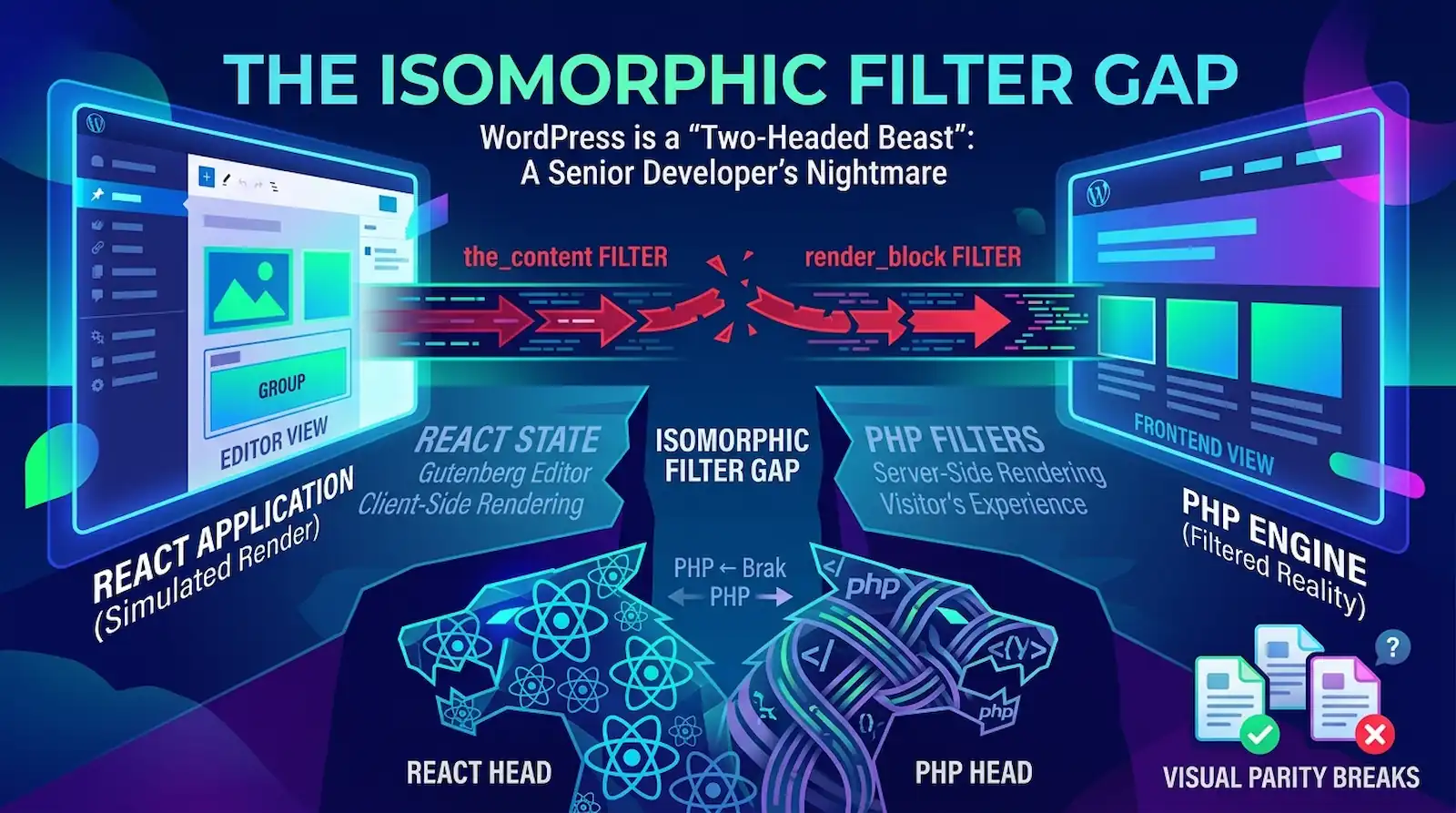
WordPress is no longer a monolithic PHP application. The architectural transition from a server-side engine to a decoupled, JavaScript-driven block editor has introduced a fundamental structural disconnect known as the Isomorphic Filter Gap. For senior developers, this gap is the primary source of the “works on the frontend, broken in the editor” frustration.
This gap represents the failure of the WordPress core to achieve a unified rendering pipeline where filters applied on the server are mirrored in the client-side editor. In the legacy era, a single hook like the_content acted as a universal gatekeeper. Today, the platform is a “two-headed beast”. One head is a React-based application prioritizing local state and user experience; the other is a legacy PHP engine prioritizing the visitor’s experience through hooks and filters.
An architectural disconnect in WordPress where server-side PHP filters applied to blocks are not mirrored in the client-side React editor. This creates a “Shadow Render” where the administrative preview differs significantly from the published frontend.
The technical reality is blunt: the block editor does not actually “render” blocks in the traditional sense. It simulates them. Because the Gutenberg editor relies on a JavaScript-centric model to provide live previews, many core blocks ignore PHP filters entirely within the administrative interface. This simulation is fundamentally incompatible with the 20-year-old PHP filter system, creating a permanent state of technical debt.
As WordPress moves deeper into the Full Site Editing (FSE) era, this disconnect manifests as a series of disparities that compromise developer experience and block integrity. The platform is effectively “forking” its own extensibility model. Developers who rely solely on render_block find their products increasingly disconnected from the user’s visual reality, while those attempting to bridge the gap face increased maintenance costs and redundant code.
The Shadow Render: Disparities in Block Rendering Logic
You register a render_block filter to modify attributes or inject custom wrappers. The frontend reflects these changes perfectly. Yet, the moment you open the editor, your modifications vanish. This is the friction point where the “Two-Headed Beast” reveals its true nature. The editor head sees the raw block data, while the frontend head sees a filtered reality.
The phenomenon of the “Shadow Render” describes a critical failure in the WordPress block editor’s design: the systematic bypassing of server-side PHP filters during the React-based editing session. In the legacy WordPress era, the the_content filter acted as the universal gatekeeper. If you modified the output there, it was globally consistent. The shift to the block model introduced render_block as the modern equivalent, but it lacks the same jurisdictional reach.
However, because the Gutenberg editor relies on a JavaScript-centric rendering model to provide a live preview, many core blocks ignore these PHP filters entirely within the editor interface, creating a profound visual disparity between the backend administrative view and the published frontend. The editor does not execute a full PHP render cycle for every block on the canvas. Instead, it prioritizes client-side React state to maintain a high-performance editing experience.
The “Shadow Render” is not a bug; it is an architectural byproduct of the editor’s reliance on client-side state. If your logic lives exclusively in a render_block filter, it does not exist within the Gutenberg canvas.
This architectural decision creates a “dark zone” for server-side logic. When React manages the DOM, PHP is relegated to the background, rendering your filters invisible to the user during the creation process. Developers are often forced into redundant development—mirroring PHP logic in JavaScript—to bridge this gap. This duplication isn’t just inefficient; it is a vector for technical debt. The system effectively forks the rendering logic, leaving the editor to simulate a preview that intentionally ignores the server’s instructions.
Case Study: The Decoupling of the Navigation Block
You inject a custom CSS class into a navigation item via a PHP filter and expect to see the visual change in the Site Editor. You see nothing. The editor displays a vanilla menu while the frontend renders your custom logic perfectly. This is not a caching error. The Navigation block serves as the most prominent example of the Shadow Render failure.
This block exists in two separate worlds. On the frontend, the Navigation block is rendered through a PHP callback that often interacts with the wp_nav_menu() logic. This allows developers to use familiar hooks to manipulate menu output. However, inside the Gutenberg editor, the block is managed by a React Edit component that utilizes innerBlocks to provide a drag-and-drop interface. In this environment, the “React head” of the beast is the sole authority. It constructs the menu based on its own internal state, ignoring the PHP rendering logic entirely to ensure the interface remains performant and interactive.
Modifications to the Navigation block via render_block filters (such as custom CSS classes or accessibility attributes) are “ghost” changes—they exist in the frontend HTML but are fundamentally absent from the editor’s React state.
The core of the issue is the update lifecycle. The investigation found that the render_block_{$this->name} filter is technically triggered on the server, but because the editor does not perform a full server-side render for every change, the React state remains out of sync with the PHP-filtered output. When you move a menu item or change a label, React updates the local DOM immediately. It does not wait for a server round-trip to see if a PHP filter wants to add a class or wrap the item in a <span>. The result is a persistent state of visual lying: the editor shows a “clean” version of the block, while the frontend serves the “filtered” version. This decoupling forces developers to maintain dual-path logic—writing the same filter twice, once in PHP and once in JavaScript—just to achieve basic visual parity.
The Vatican Principle and Contextual Isolation
Senior developers often assume that a block hierarchy implies a data hierarchy. In traditional PHP templating, a parent container sets the scope, and children inherit that scope naturally. The Block Editor destroys this assumption. In the FSE architecture, the relationship between a parent block and its children is not one of inheritance, but of strict isolation.
An architectural paradigm in the Block Editor where each block operates as a “sovereign state,” strictly isolating its context and preventing the natural downward flow of server-side filtered data to nested child blocks.
The “Vatican Principle” refers to the architectural isolation where the parent block behaves like a sovereign state—it does not inherently pass its filtered state or context down to child blocks unless explicitly instructed via the render_block_context filter. This isolation creates a reality where a parent block can be modified by a server-side filter, but its children remain completely unaware of those changes. If you use a filter to inject a data attribute into a Group block, that attribute is invisible to the Paragraph block inside it. The “React head” of the platform views these blocks as distinct nodes in a tree, while the “PHP head” fails to bridge the gap between them during the render cycle.
The friction intensifies when you attempt to use the provided core tools to fix this. Trac Ticket 62046 highlights a fundamental inconsistency: the render_block_context filter behaves differently on top-level blocks compared to inner blocks, leading to a breakdown in context inheritance. When a block is at the root level of a template, the context filter handles its data one way. When that same block is nested as an inner block, the inheritance logic shifts. This inconsistency means that your logic for passing data through the block tree is inherently fragile. You cannot rely on a unified “global” state.
This breakdown forces a defensive coding style. Developers must explicitly map and “re-inject” context at every level of the nesting. It is a manual overhead that contradicts the promise of a streamlined block-based workflow. The isolation isn’t a security feature; it is an architectural byproduct of a system that prioritizes individual block autonomy over a cohesive document state. This sovereignty ensures that blocks remain portable, but it does so by sacrificing the predictable flow of server-side data. The result is a fractured rendering environment where the parent’s reality is intentionally hidden from the child.
The failure of context to flow downward is only the beginning of the isolation. A more severe disparity exists when blocks are placed at the absolute root of the document, where even the most basic HTML filters are bypassed entirely.
The Root-Level Bypass: The HTML Block “Ugly Truth”
You configure a visibility rule to hide a specific snippet from unauthorized users, placing the core/html block at the root of your template. On the frontend, your logic fails—the content remains visible to everyone. This is not a plugin conflict. It is the Root-Level Bypass, a silent failure of the WordPress block parser that exposes the fundamental fragility of server-side filters.
Investigative logs in GitHub Issue #64420 show that when a core/html block is placed at the very root of a template or template part, it is not treated as a block by the parser. Instead of identifying a discrete block type, the system defaults to the “freeform content handler,” which preserves the content as a raw string. In this scenario, the “Two-Headed Beast” is at its most deceptive: the React editor presents a standard block interface, but the PHP parser sees unstructured, legacy text.
Because the render_block filter requires a valid $block[‘blockName’] to execute, and the freeform handler returns a null name for root-level HTML, any visibility logic or content modification applied via PHP filters is completely bypassed. The hook simply never fires. If the parser cannot assign a name, the filter engine lacks the necessary jurisdictional trigger to apply your logic.
Root-level HTML blocks are processed as raw strings by the freeform handler. Because they lack a valid blockName, they bypass the render_block filter entirely. If you rely on PHP filters for access control or visibility, these blocks will remain visible to all users unless nested within a container block.
This creates a massive security and functional hole where content that should be hidden (via plugins like Block Visibility) remains visible on the frontend if the user simply forgets to wrap the HTML block in a Group block. The platform assumes that all content on the canvas exists within the standard block lifecycle. However, the root level remains a lawless zone where the parser prioritizes raw preservation over filtered execution.
This mechanical failure extends beyond mere visibility logic. It fundamentally alters how the database stores and validates attributes, leading directly to the phenomenon known as the Attribute Sinkhole.
The Attribute Sinkhole: Navigating Block Invalidation
You deploy a routine PHP filter to inject a wrapper div into a core block for a layout update. The frontend looks perfect. However, when you or your client opens the editor, every instance of that block has exploded into a graveyard of “This block contains unexpected or invalid content” warnings. This is the Attribute Sinkhole. It is the point where the “Two-Headed Beast” turns on itself—the React head rejects the reality created by the PHP head.
The “Attribute Sinkhole” is the technical consequence of attempting to solve the Shadow Render problem by injecting structural HTML via PHP. Developers often use render_block to fix visual gaps, but they forget that the editor is a forensic auditor. The WordPress block editor operates on a strict validation contract: the HTML saved in the post_content must match the output generated by the block’s JavaScript save() function. If the markup in the database includes a single extra tag or attribute that the block’s registration logic didn’t account for, the contract is breached.
When you inject structural elements (like a wrapper div or additional span) via PHP that were not registered in the block’s block.json schema, the React-side validation engine will flag the block as corrupt. This is the “Attribute Sinkhole”—where your PHP logic and JS schema fall out of alignment.
If the PHP render_block filter has modified the content in a way that the save() function did not anticipate, the block is flagged as ‘invalid’. This triggers the ‘This block contains unexpected or invalid content’ warning, and users are presented with a ‘Resolve’ or ‘Convert to HTML’ prompt. For a senior developer, this means total paralysis. The “Resolve” button usually forces the block back to its default JS state, stripping away your server-side modifications and leaving the frontend broken. This tension between runtime modification and save-side integrity creates a permanent state of fragility.
The fundamental issue is that render_block operates at the wrong end of the stream for blocks that require structural persistence.
The Paradox of Save-Side vs. Runtime Filters
You are writing the same logic twice. Once in JavaScript to satisfy the editor’s “React head,” and once in PHP to satisfy the frontend’s “PHP head.” This is the dual-maintenance nightmare of the modern WordPress developer. It is not an efficiency choice; it is a structural necessity forced by two competing philosophies of data persistence.
The architectural paradox lies in the timing of execution: JavaScript filters like blocks.getSaveElement modify the ‘Physical Record’ (the static HTML stored in the database), while PHP render_block filters modify the ‘Virtual Layer’ (the dynamic output at runtime). When you use a JavaScript filter, you are permanently altering the block’s DNA before it ever hits the database. The result is “hard-coded” into the post_content column. Conversely, a PHP filter is a fleeting intervention. It catches the block data as it leaves the server, dresses it up for the visitor, and then vanishes.
blocks.getSaveElement is a permanent mutation of the block’s markup. render_block is a temporary, non-destructive filter applied only when the page is served. They are not interchangeable; they are competing philosophies.
This timing discrepancy creates a massive blind spot for the Block Editor. Because the Block Editor uses the saved HTML as the source of truth for the React-side preview, a runtime PHP filter is, by definition, invisible to the editor’s reconciliation engine. The editor does not “see” what your PHP hooks are doing because those hooks haven’t fired yet. They only exist in the future, at the moment of the frontend request. This is why your custom wrappers or attribute injections appear on the live site but fail to materialize in the Gutenberg canvas.
The ‘Ugly Truth’ identified in GitHub Discussion #63876 is that WordPress currently lacks a standardized mechanism to share logic between these two layers, forcing developers to maintain duplicate logic in both PHP and JavaScript or accept a broken administrative experience. There is no “bridge” for logic. If you need a block to behave a certain way, you must convince both heads of the beast separately. If you fail to do so, the editor treats your server-side modifications as “invalid content,” triggering recovery errors that haunt your support tickets.
This architectural schism does more than frustrate developers; it creates a tangible drag on the system’s ability to serve content efficiently.
The Performance Tax: Fixing Double-Filtering and LCP Lag
Your TTFB (Time to First Byte) isn’t just a reflection of your hosting environment; it is increasingly a casualty of the “Two-Headed Beast.” Because WordPress fails to provide a unified rendering pipeline, developers pay a “Performance Tax” every time they bridge the gap between React and PHP. This tax manifests as “Filter Inflation,” where the lack of a unified pipeline forces the engine to execute logic redundantly—once during block registration and again during the render_block execution.
Each block essentially undergoes a double identity crisis. The system processes the block’s attributes during the initial parsing phase and then forces the server to re-evaluate those same attributes through a gauntlet of filters at runtime. Trac Ticket #55996 highlights how redundant filtering on media blocks, particularly when injecting lazy-loading attributes, can introduce 150ms–300ms of additional server-side processing for complex template parts. In a high-traffic environment, this overhead is the difference between a snappy user experience and a sluggish, frustrated bounce.
Redundant filtering doesn’t just bloat your PHP execution time; it creates a “reconciliation debt” where the browser must parse conflicting attributes, directly penalizing your LCP score.
This inefficiency leads directly to what we identify as “LCP Lag.” This is not merely a PHP execution delay; it is a structural failure where conflicting logic between core’s native optimization and custom filters results in sub-optimal DOM structures that delay the browser’s paint cycles. When the “PHP head” injects attributes that conflict with the “React head’s” saved state, the browser is forced to resolve these discrepancies before the first meaningful paint.
The engine is effectively fighting itself. One layer of core attempts to optimize for performance while another layer—your filtered logic—is forced to re-process the same data because it was never made available to the initial registration cycle. This circular logic doesn’t just waste CPU cycles; it degrades the final output, bloating the HTML with redundant or conflicting attributes that force the browser’s rendering engine to work harder than necessary.
The structural disconnect is even more pronounced when dealing with the “Contextual Ghost”—the phenomenon where nested blocks lose access to the very filters meant to manage them.
Recursive Pass and Hero Image Corruption
You have optimized your hero image, ensured it is the first element in the viewport, and yet PageSpeed Insights still flags it for being lazy-loaded. You check your code, but the loading="lazy" attribute is being injected by core logic you didn’t touch. This is the “Recursive Pass” failure— a direct result of how the Full Site Editor (FSE) handles template hierarchy.
WordPress includes logic to automatically add loading=’lazy’ to images, but it is designed to skip the first image on the page to prevent delaying the Largest Contentful Paint (LCP). In a classic theme, this works reliably because the render path is linear. In the “Two-Headed Beast” architecture of FSE, the render path is recursive and fractured.
In block themes, the function get_the_block_template_html() processes the entire page template. However, inside that template, the post-content block then triggers the_content filter again. This creates a double-pass scenario. Because the image counter has already been incremented during the first template pass, the actual hero image of the post is incorrectly identified as a subsequent image and is given the loading=’lazy’ attribute. The engine loses track of “first” because it has already counted images hidden within the template’s header or sidebar before it ever reaches the actual content.
In FSE, the first pass of the template increments the global image counter. By the time the post-content block renders, your hero image is effectively “the second image” in the eyes of the engine. It gets lazy-loaded. Your LCP score tanks.
This bug, which went unnoticed for several versions of FSE, results in a direct and measurable decrease in site performance scores. It is the ultimate irony of the modern WordPress stack: the very system designed to automate performance optimization ends up sabotaging it due to an architectural inability to maintain state across recursive render cycles. You are left fighting a core “optimization” that is fundamentally blind to the context of the blocks it is processing.
The Final Verdict: Navigating the Technical Debt
The “Two-Headed Beast” is the permanent reality of the WordPress landscape. You cannot wait for a patch to fix the structural disconnect between React and PHP. The “Isomorphic Filter Gap” is not a temporary bug; it is the defining architectural challenge of the Gutenberg era. It represents a shift from a unified rendering engine to a bifurcated system where visual parity is no longer guaranteed by the core software.
The investigation concludes that the Information Gain missed by 99% of tutorials is that the block editor does not actually “render” blocks in the traditional sense; it simulates them. This simulation prioritizes an interactive UI over architectural consistency. When you apply a render_block filter, you are modifying a reality that the editor’s React state simply does not acknowledge. The editor is looking at the raw attributes and the save() output, while the frontend is looking at your filtered PHP. They are looking at the same data but perceiving different realities.
The platform is effectively “forking” its own extensibility model. Developers who rely solely on render_block will find their products increasingly disconnected from the user’s visual reality. This fork creates a mandatory technical debt. If you want a feature to work across the entire platform, you must adopt “Double-Implementation.” You are forced to write a PHP filter for the visitor and a corresponding JavaScript filter for the creator. This is the maintenance tax of the modern WordPress stack. It is redundant, increases the surface area for bugs, and fragments your codebase.
The Interactivity API is often framed as the solution, yet it currently addresses client-side behavior rather than structural HTML filtering. It does not bridge the gap for developers needing to inject server-side logic into the editor canvas. Until these two pipelines are unified—perhaps through a true server-side rendering (SSR) requirement for all core blocks or a shared logic layer like the Interactivity API—the Isomorphic Filter Gap will continue to be the primary source of frustration for professional WordPress developers. WordPress has prioritized the speed of the editing interface over the integrity of the rendering pipeline. This is a deliberate choice that leaves the developer to carry the burden of reconciliation. You are no longer just a PHP developer or a JavaScript developer; you are an intermediary constantly trying to sync two disparate engines that were never designed to truly speak the same language.
You can ignore the React head and accept a broken editor experience for your users, or you can embrace “Double-Implementation” and pay the maintenance tax. Until WordPress provides a unified rendering pipeline, there is no third option.
FAQs
render_block save() function exactly; unexpected modifications cause validation failure. editor.BlockEdit) and a matching PHP filter for the frontend.