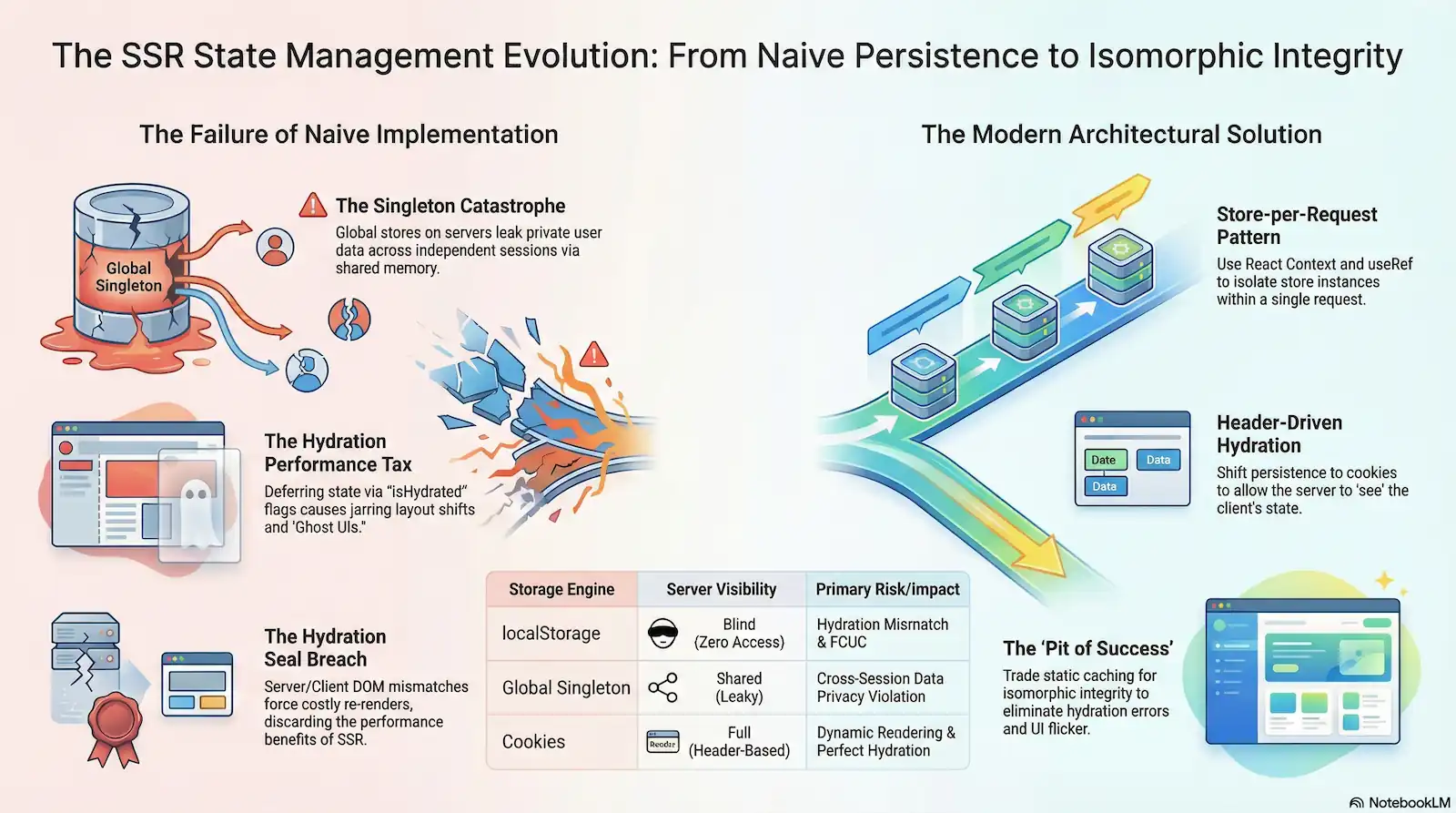
The architectural shift toward aggressive Server-Side Rendering (SSR) and React Server Components (RSC) creates a technical friction point that standard state management tutorials effectively ignore. These guides prioritize “quick fixes” that silence console errors while burying structural flaws. In reality, the server is “blind” to the client’s past. Operating in isolated Node.js or Edge runtimes, the server possesses zero knowledge of browser-specific storage like localStorage or IndexedDB. This is more than a missing API; it is a chronological conflict between the server’s static render and the client’s persisted history.
This analysis bypasses surface-level implementation guides to expose how naive persistence compromises data security and Core Web Vitals.
This fundamental environmental mismatch triggers a cascading series of architectural failures for state management libraries. Most developers reach for a isHydrated boolean to bypass these issues, but this “standard” fix is a deceptive anti-pattern. Our objective is to surface the highly technical “Information Gain” that falls outside the scope of SEO-optimized tutorials, exposing the precise mechanisms by which naive implementations of persistent state compromise application performance, accessibility, and user data security.
The Hydration Seal: Why the Server is Blind to localStorage
The ReferenceError: window is not defined overlay is the first diagnostic indicator of a breached architectural boundary. It confirms that code intended for a browser-centric persistence layer has leaked into a Node.js or Edge runtime. This is not a trivial configuration error; it is a fundamental collision between two isolated execution environments that defines the modern “Hydration Seal.”
The server, operating in an isolated Node.js or Edge runtime environment, possesses absolutely no knowledge of client-specific persistent storage mechanisms such as localStorage, sessionStorage, or IndexedDB. During the SSR pass, the server must generate a deterministic string of HTML based solely on the data it can access—typically a “clean” or default initial state. Yet, the React framework demands strict, mathematically precise HTML parity between the server-rendered output and the initial client-side virtual DOM render.
Hydration is a “Double-Pass” problem. If the first pass (Server) and second pass (Client) result in different HTML structures, React discards the server-rendered DOM, destroying the performance benefits of SSR.
When a Zustand store hydrates from storage immediately upon client-side instantiation, it injects the “client’s reality” into the first render pass. If that reality—such as a persisted user theme or a shopping cart count—alters the DOM structure from the server’s initial “guess,” the hydration seal breaks. This environmental mismatch forces a costly re-render and a full DOM replacement, negating the efficiency of pre-rendering. This diagnostic reality confirms that the mismatch isn’t a bug to be suppressed, but a fundamental architectural constraint of the isomorphic environment.
The High Cost of Deferral: FOUC, CLS, and Accessibility Gaps
The user selects Dark Mode. They reload the page. For exactly 500 milliseconds, they are blinded by a high-latitude white screen before the UI snaps into the correct persisted state. This jarring shift is the “Performance Tax” of lazy hydration. When you defer rendering until hydration—the isHydrated pattern—you aren’t fixing the hydration error; you are simply hiding it behind a performance tax.
The result is a Ghost UI. The server-sent HTML is discarded or ignored, leading to measurable Cumulative Layout Shift (CLS) and a jarring Flash of Unstyled Content (FOUC) that fails Core Web Vitals. This isn’t just a visual glitch; it is DOM churn. By gating your components behind a client-side mounting check, you force the browser to throw away the pre-rendered work processed by the server.
Using a “mounted” state to gate your UI creates a ‘content-less’ first paint for search engine crawlers, effectively nuking the SEO benefits of choosing Next.js in the first place.
Accessibility gaps widen during this window. If a component remains non-interactive for 1.5 seconds while the main thread processes the hydration gate, you have shipped a dead UI. Search bots encounter a “null” state or a generic skeleton screen rather than the actual content, inflating Total Blocking Time (TBT). This diagnostic reality confirms that “hiding” the error via an isHydrated band-aid does nothing to solve the architectural mismatch.
The Persistence Lag: Microtasks and Micro-Stutters
The user clicks a checkbox. The input stutters for 150 milliseconds. This frame-drop is the diagnostic signature of an architectural mismatch between the V8 event loop and the persistence layer. While developers often blame React’s reconciliation, the culprit is frequently the synchronous performance tax of high-frequency state serialization.
Zustand treats the retrieval of data from even synchronous storages as an asynchronous operation during the initial hydration phase. This process is orchestrated via an internal toThenable wrapper function. Because toThenable defers state resolution to a microtask but does not return a native JavaScript Promise, Next.js does not comprehend that it needs to defer initialization. The runtime effectively “outruns” the store, creating an aggressive race condition where the UI renders before the persisted state is actually available to the component tree.
Returning an explicit native Promise from the getItem method is a mandatory “hack” to ensure the Next.js runtime defers component tree initialization until storage is stable.
Beyond the race condition, the CPU cost of state management is often ignored until it hits a breaking point. Serialization and deserialization (JSON.stringify) are CPU-intensive operations that execute synchronously on the main thread. If the state tree is massive, the entire browser UI completely freezes during the hydration pass. This blocking operation prevents the main thread from handling user input or executing other critical microtasks.
The choice of storage engine dictates the severity of this lag. While localStorage is accessible and simple, its synchronous nature on the main thread makes it a liability for complex applications. Moving to IndexedDB shifts the retrieval off the main thread, but introduces the complexity of managing purely asynchronous state transitions during the critical hydration window.
The Singleton Catastrophe: Cross-Session Data Leakage in RSC
Your global store is a memory leak waiting to happen. In a standard Single Page Application (SPA), the line export const useStore = create(...) is safe because the execution environment is a private browser tab. In the Next.js App Router, that same line of code is a security liability. The server’s memory is a shared pool, not a private room.
If a Zustand store is declared as a global, module-level variable on the server, it persists in the active memory of that server thread for the entire lifecycle of the server process. This fundamentally violates the stateless nature of React Server Components (RSC). When User A logs into the application and makes a request, their data is permanently burned into the server’s RAM. If User B then makes a completely independent request to the same warm server instance, User B is immediately served a fully rendered page containing User A’s private, persistent data.
In a serverless or containerized environment, a single warm instance can serve hundreds of users. If state is mutated on the server, that mutation becomes “global” for every subsequent user hitting that instance.
Attempts to mitigate this with skipHydration: true fail. This flag does absolutely nothing to resolve the underlying singleton leakage on the server; it only manages how the client handles the initial payload. It does not protect the server-side Node.js memory space from cross-contamination. The assumption that module-level globals are safe in SSR is lethally flawed. This is a high-stakes data privacy violation.
Architecting for Stability: The Store-per-Request Pattern
Discard the global hook. Moving state from the module scope to the component tree is the mandatory architectural pivot for securing multi-tenant Next.js applications. To absolutely prevent the leakage of persistent state across server threads, Zustand must never be initialized as a global, module-level singleton. Instead, you must treat each incoming request as a sterile environment—a “Clean Room” where state is instantiated, utilized, and destroyed within the strict boundaries of a single execution context.
The implementation begins by shifting from the standard create hook to createStore from zustand/vanilla. This creates a store factory rather than a global instance. The application must then inject this per-request store instance into the React rendering tree using the React Context API. By moving the store into Context, you bind its lifecycle to the component tree rather than the server process memory.
Initializing the store inside useRef ensures that the store instance remains stable across re-renders of the Provider, preventing accidental state resets during the client-side lifecycle.
Inside a StoreProvider component, a useRef hook is used to initialize the store exactly once per user session, passing the result into the Context Provider’s value prop. This pattern ensures that the store is “pinned” to the specific request during SSR. Once the server finishes the render pass and streams the HTML to the client, the local store instance becomes eligible for garbage collection. It does not linger in the Node.js RAM, effectively eliminating the risk of cross-session contamination.
This structure creates a predictable, deterministic state container that respects the stateless requirements of React Server Components. While this solves the critical security failure of the singleton pattern, it does not address the visual “flicker” or Flash of Unstyled Content (FOUC) inherent in deferred hydration. The structural integrity of the store is now sound, but the chronological conflict between storage and render persists.
The “Pit of Success”: Achieving Perfect SSR with Cookie Hydration
The server finally “sees” the client’s state through HTTP headers. This is the architectural “Aha!” moment that resolves the chronological conflict. To achieve true, seamless hydration, the Next.js server must have physical access to the persistent data during the initial HTML generation phase. Because the server cannot access localStorage, the persistence layer must be entirely shifted to browser Cookies.
By writing a custom storage engine for the Zustand persist middleware that serializes state to a cookie, the state becomes attached to the headers of every request. This shift enables header-driven hydration, allowing the server to pre-populate the store instance before the first byte of HTML is ever streamed.
Utilizing the cookies() function from next/headers during the store initialization phase automatically opts the route into dynamic rendering. This ensures the server always has the latest user context at the cost of static edge caching.
In Next.js, the cookies() utility is classified as a Dynamic Function. Invoking it immediately forces that specific route into dynamic rendering, effectively bypassing aggressive static caching. This is the “Pit of Success” trade-off: you sacrifice the theoretical performance of Static Site Generation (SSG) to gain the actual, user-perceived performance of a zero-mismatch render.
The resulting HTML payload sent over the wire perfectly matches the state the client expects. The isHydrated boolean flag and the useEffect mounting hacks are entirely eradicated. This isomorphic state synchronization ensures that the server’s “guess” is no longer a guess—it is a data-driven reflection of the client’s reality. This is the only path to eliminating FOUC and maintaining the structural integrity of Core Web Vitals in complex persistent applications.
The Final Verdict: Achieving 2026 Architectural Standards
The industry’s reliance on the isHydrated hook is a technical debt generator disguised as a best practice. It represents a failure to architect for the medium. Suppressing a hydration error is not a solution; it is a concession that your application is functionally broken for the first half-second of every user session. Achieving true architectural stability and performance in this stack requires abandoning naive, tutorial-level implementations in favor of system-level awareness.
Engineers must enforce rigid environmental boundaries. This begins by entirely discarding global store singletons—the primary vector for cross-session data leakage—and embracing Context-wrapped, per-request store initializations. By binding the store’s lifecycle to the React tree, you ensure that multi-tenancy is a feature, not a vulnerability.
Modern Next.js development is no longer about suppressing hydration errors; it is about ensuring the server possesses the same context as the client. Anything less is a compromise on performance and security.
To achieve perfect hydration without visual degradation, persistence layers must transition away from isolated browser APIs like localStorage and embrace cookie-based state synchronization. This is the only path to isomorphic integrity. Only through these rigorous architectural patterns can the promise of isomorphic React state management be safely realized. The server can no longer remain a “black box” to the client’s past. Environmental awareness is now the fundamental requirement for high-performance SSR architectures.
Edge Cases Q&A
localStorage. React requires the first client render to match this “blind” HTML exactly.