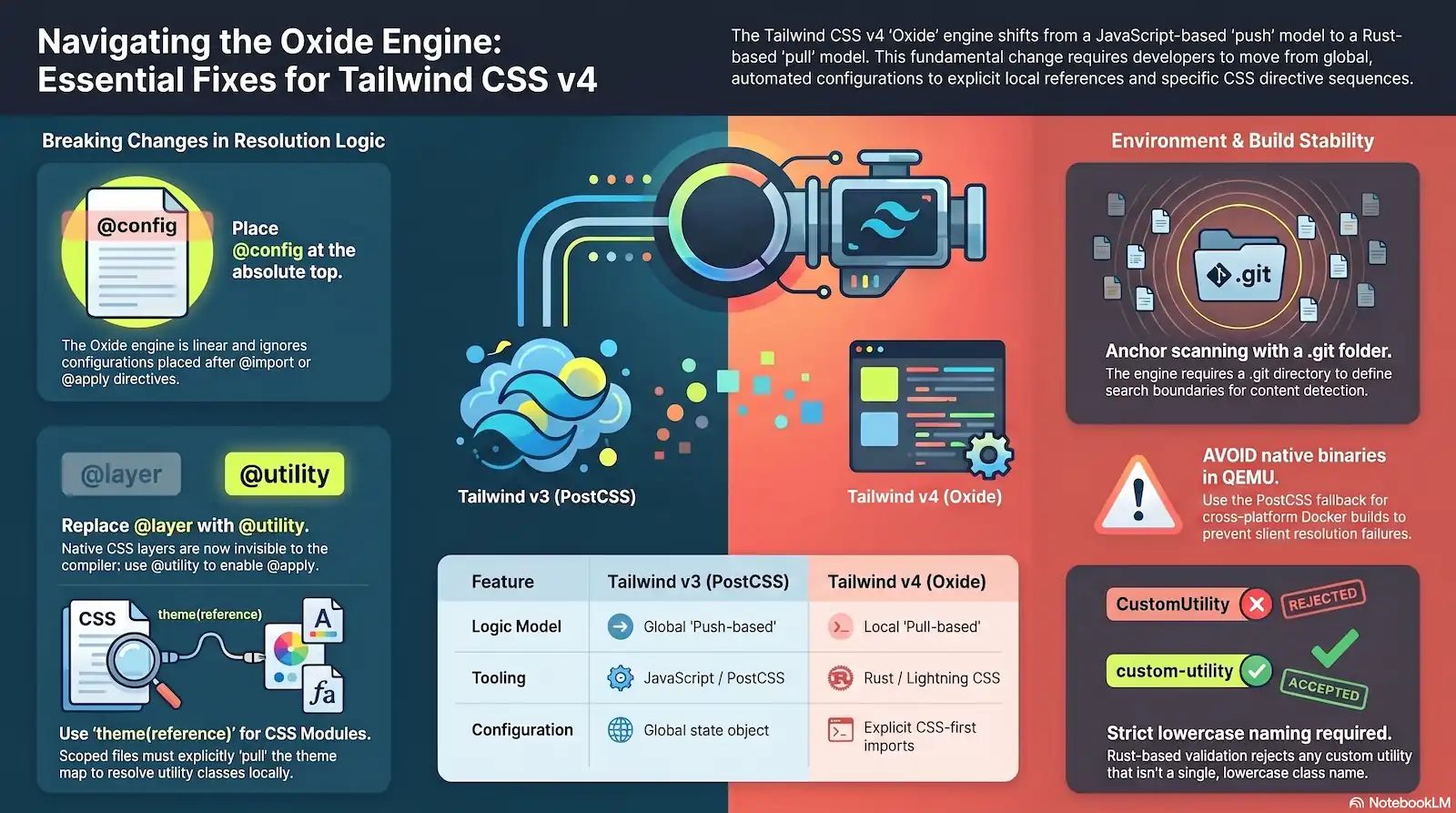
The “Unknown utility class” error has become the primary friction point for teams transitioning to the Oxygen era. It is a clinical failure of the resolution logic that breaks battle-tested workflows. Developers migrating to Tailwind CSS v4 often find that their battle-tested @apply directives suddenly throw ‘Unknown utility class’ errors, despite no changes to their CSS logic. The ‘Information Gain’ lies not in the performance benchmarks, but in the systematic breakdown of the @apply directive—a core feature of the framework that has historically bridged the gap between utility-first logic and traditional CSS authoring.
The Oxide engine represents a fundamental departure from the framework’s historical reliance on the JavaScript-based PostCSS ecosystem. While marketing documentation emphasizes performance gains from the Rust-based compiler, technical audits reveal a more problematic reality. This architectural shift introduces systematic regressions in how the compiler resolves utility candidates that are not part of the standard, built-in library.
Tailwind v3 operated on a “push-based” model. The configuration file acted as a global state object, pushing its definitions into every file in the project build. Oxide reverses this flow. It adopts a “pull-based” resolution logic where the compiler only recognizes what is explicitly referenced or imported within the local CSS tree. It builds the theme context incrementally for each entry point rather than maintaining a persistent global cache. This “Black Box” prioritizes raw compilation speed and modern browser targets over the flexible, global behavior of previous versions. For professional developers, the stakes are high; these resolution bottlenecks now threaten the stability of production pipelines in heterogeneous build environments.
The Order of Operations Trap: Why @config Must Be First
Your tailwind.config.js isn’t “missing”—it’s being ignored by the parser. In the Oxide engine, the order of directives is a hard technical requirement, not a stylistic preference. Tailwind v3 relied on a JavaScript-heavy global state that allowed the configuration to exist outside the CSS flow. Version 4 dismantles this. It uses a strict, CSS-first “pull model” where the Rust core builds the theme context incrementally as it reads the entry file.
The resolution logic is linear and unforgiving. “Tailwind requires @config to be at the top of your CSS file before any @import statements or it won’t apply your configuration correctly… If the engine parses an @import ‘tailwindcss’; or an @apply before the @config directive has been processed, the legacy utilities remain invisible to the Rust core during the resolution phase.“ To ensure the compiler captures your custom theme before it begins utility generation, you must follow this exact sequence in your entry CSS:
@config "./tailwind.config.js";
@import "tailwindcss";
If you deviate, the engine treats the source as a vanilla installation. It creates a closed environment where your theme.extend objects effectively do not exist. It does not backtrack.
Placing the @config directive after an @import statement triggers a silent resolution failure. The Oxide engine will initialize with default settings, leaving your custom theme extensions unreachable by @apply.
This linearity forces a shift in how we author entry points. The Oxide Black Box does not backtrack once the resolution phase initiates, moving the complexity from the configuration file into the structure of the CSS layers themselves.
The Layer Paradox: Why @layer base No Longer Resolves
Your @layer base and @layer components blocks are now invisible to the compiler’s composition engine. In Tailwind v3, these directives acted as internal “buckets” that the PostCSS plugin indexed and made available for global @apply resolution. The Oxide engine abandons this abstraction. It treats @layer as a native CSS feature, offloading layer management to the browser’s own implementation while leaving those classes outside the engine’s “utility candidate” index.
If you used @layer to organize complex component logic, that logic is now a dead end for the compiler. The architectural shift to a rigid pull model means the engine only “sees” what is explicitly registered as a utility. As one developer identified during a migration audit: “@apply doesn’t work with @layer base and @layer components classes anymore in v4… I am forced to define all base, components and utilities layers with @utility to be able to use those classes with @apply which of course would create a big mess.” To make a class discoverable by the Rust-based parser, you must migrate from layer-based organization to the @utility directive:
/* v3 - Resolvable by @apply */
@layer components {
.btn-primary { @apply bg-blue-500; }
}
/* v4 - Required for @apply resolution */
@utility btn-primary {
@apply bg-blue-500;
}
In Tailwind v4, the Oxide engine treats the @layer directive as a native CSS feature. It no longer indexes these classes for composition. To make a class “discoverable” by the @apply parser, you must use the new @utility directive.
This isolation within the Oxide Black Box effectively severs the link between thematic base styles and utility composition, creating immediate friction in scoped environments where style encapsulation is paramount.
Scoped Blindness: The Reference Crisis in CSS Modules
Standard utilities like flex are suddenly “unknown” inside your .module.css files. This is the Oxide engine treating your CSS Modules as isolated silos. In version 3, the PostCSS plugin maintained a shared global state across the entire build. Version 4 discards this. Every file processed by Vite, Webpack, or Next.js now acts as an independent entry point. If the compiler cannot see the theme, @apply fails.
You must build the bridge manually. The “pull-based” resolution logic requires each scoped file to explicitly request the utility map. “In Tailwind v4 there is no concept of a global config, instead each Tailwind CSS file will need to import the theme… @import ‘tailwindcss/theme’ theme(reference); @config ‘../tailwind.config.ts’;.test { @apply test-component; }“ Without this explicit reference, the Rust-based parser begins its resolution phase with an empty manifest, resulting in immediate build errors for any utility composition.
@import "tailwindcss/theme" theme(reference);
@config "../tailwind.config.js";

.my-scoped-component {
@apply flex items-center justify-between;
}The theme(reference) syntax is the critical “pull” mechanism for the Oxide engine. It grants the local file access to the theme’s utility map for @apply resolution without duplicating the entire Tailwind utility payload in your final CSS bundle.
This isolation forces a trade-off: you gain compilation speed but lose the “zero-config” convenience of the previous generation. The engine now operates with total scoped blindness unless instructed otherwise by the filesystem’s own hierarchy.
The .git Heuristic: When Automatic Scanning Fails
Your styles work perfectly on your local machine but vanish the moment they hit the CI/CD runner. This is the breakdown of the Oxide engine’s primary heuristic for content detection. The “zero-config” magic of version 4 relies on a fragile assumption about your filesystem hierarchy. To determine which files to scan for utility classes, the engine requires a definitive anchor.
The Oxide Black Box uses the existence of version control metadata to establish its search perimeter. The Oxide engine identifies the repository root—and thus the scanning boundary for content detection—by searching for a .git directory. If a developer initializes a project without a Git repository, or if the build environment (such as a CI/CD pipeline or a Docker container) does not include the .git folder, the engine’s content scanning logic breaks down entirely.
In ephemeral build environments or slimmed-down Docker images, the .git folder is frequently stripped to optimize image size. This breaks the “pull model.” Without a boundary, the scanner may fail to locate your source files or, conversely, attempt to index the entire container. If your pipeline strips metadata, you must anchor the scanner manually by creating a dummy directory:
# Fix for Docker/CI environments missing .git
mkdir .git
In the absence of a .git folder, the engine may perform an unbounded upward traversal of your filesystem. If a parent directory contains a .gitignore with restrictive patterns (like *), the Oxide engine will inherit those rules and silently ignore your local project files.
This reliance on filesystem state introduces environmental fragility into the build pipeline. It moves the framework away from predictable configuration and toward a dependency on the host’s directory structure, leading directly into the engine’s strict validation rules for custom plugins.
Plugin Invalidation: Lightning CSS and Complex Selectors
Major plugins like HeroUI (NextUI) are currently crashing builds by attempting to inject global variables through the legacy utility API. This is the Oxide Black Box asserting its rigid dominance. Version 4 transitions to Lightning CSS for native parsing, implementing a level of validation that the previous PostCSS-based engine never required. In the v3 ecosystem, the addUtilities function served as a flexible backdoor for general CSS injection, including :root variables and complex pseudo-selectors.
The Rust-based compiler has ended this flexibility. It treats utilities as specific, indexable entities within a strict schema. When a legacy plugin attempts to use the utility pipeline for global style injection, the engine rejects the payload with a terminal error. “Error: addUtilities({ ‘:root’ : … }) defines an invalid utility selector. Utilities must be a single class name and start with a lowercase letter, eg. .scrollbar-none.” This shift forces you to move global style declarations out of the JavaScript configuration and into the CSS entry point.
/* v3 - Failing legacy pattern */
addUtilities({
':root': { '--brand-color': '#007bff' }
});

/* v4 - Required approach (CSS-first) */
@theme {
--color-brand: #007bff;
}It is the strict schema enforcement within the Oxide engine that mandates all utilities be single, lowercase class names. This replaces the flexible, regex-based matching of the v3 PostCSS engine, effectively deprecating the use of the addUtilities API for global style injection.
This enforcement mandates a clean separation of concerns. Variables belong in the @theme block; utilities must remain strictly mapped to individual classes. The transition from JavaScript-driven flexibility to Rust-driven rigidity exposes further vulnerabilities in environment-specific binary failures.
The Silent Failure of Emulated Builds (QEMU)
Your CI/CD pipeline reports a successful build, but the resulting production site is unstyled or broken. This is the ultimate danger of the native binary approach. The Oxide engine functions as a double-edged sword: it offers extreme performance on local metal but acts as a liability in emulated containers.
The failure is often invisible until the deployment phase. “The Oxide engine’s native Rust binary fails to resolve class names and @apply directives correctly when executed under QEMU emulation during cross-platform Docker builds… Tailwind v4 ships platform-specific native binaries… the oxide binary runs under this emulation, and the class scanning / @apply resolution fails silently or produces incorrect output.” Attempting to build x64 production images on Apple Silicon (ARM64) machines is the most common trigger for this regression. The Rust core cannot reliably map utility candidates when trapped within the latency and instruction translation of QEMU.
To ensure resolution stability in these environments, you must abandon the standalone binary in favor of the PostCSS fallback. This integration forces the build back into the JavaScript ecosystem, sacrificing the speed of the Oxide Black Box for deterministic output across architectures.
// Use this integration to bypass native binary failures in QEMU
module.exports = {
plugins: {
'@tailwindcss/postcss': {},
}
}
Native Oxide binaries executed under QEMU do not always throw errors during a failed scan. This leads to “successful” builds with completely missing utility CSS. If you are building cross-platform Docker images, you must prioritize the JavaScript-based PostCSS integration to ensure resolution stability.
This architectural instability marks the final hurdle in the v4 transition, forcing a critical evaluation of the framework’s new deployment requirements.
The Final Verdict: Stabilizing Your v4 Migration
Abandon the expectation of “magic” automation. The Oxide Black Box forces a trade: you gain compilation speed but lose the automated global state of version 3. Success in this new paradigm requires a move toward explicit “pull” mechanics. The transition to the Oxide engine is not a simple version bump; it is a fundamental shift in the developer’s relationship with the CSS pipeline. By understanding the ‘Ugly Truths’ of @apply resolution and the engine’s internal heuristics, professional developers can navigate the migration without succumbing to the ‘unknown utility’ errors that represent the primary friction point of the version 4 era.
Stabilizing a production-ready pipeline starts with manual intervention. Mandate the refactoring of existing @layer component logic into the @utility directive to ensure the Rust core indexes your classes. In CI/CD runners where metadata is stripped, initialize a dummy .git directory to anchor the scanner. If your build architecture involves cross-platform emulation or complex legacy plugins, bypass the native binary entirely. Use the JavaScript-based PostCSS integration as your ultimate escape hatch for resolution failures:
module.exports = {
plugins: {
'@tailwindcss/postcss': {},
}
}For enterprise heterogeneous environments, stabilize your build by
- Refactoring @layer to @utility,
- Explicitly referencing theme state in modules, and
- Mocking a .git root in isolated CI environments.
Direct your focus toward explicit configuration. The heterogeneous reality of modern enterprise web development leaves no room for fragile heuristics.
FAQs
@layer are treated as native CSS layers and are not indexed for @apply. You must use the @utility directive to make them resolvable. @config directive must be the absolute first line. If it follows @import "tailwindcss";, the compiler will fail to see your custom configuration during the resolution phase. @import "tailwindcss/theme" theme(reference); to every scoped CSS file using @apply. .git directory, the Oxide engine may fail to identify the project root or apply incorrect restrictive patterns from parent .gitignore files.